

The lessons of 1874
The first midterm "wave" election of the modern era and what it portends for Republicans in 2026.

In the aftermath of President Ulysses S. Grant’s landslide re-election over Horace Greeley in 1872, Republicans who surveyed the political landscape could conclude with justification that all prospects pleased.
Grant carried 29 of the 35 states where ballots were cast in his race against Horace Greeley, the quixotic editor of the New York Tribune nominated for president by dissident liberal Republicans and demoralized Democrats. In the House, Republicans won a 111-vote majority over Democrats. Republicans held a 47-19 majority in the Senate.1
“The Republican Party naturally considered itself invested with a new lease of power,” James G. Blaine wrote in the second volume of his authoritative history, Twenty Years of Congress. “The victory in the presidential election of 1872 had been so sweeping, both in the number of states and in the popular majorities, that it seemed as if no reaction were possible for years to come.”2
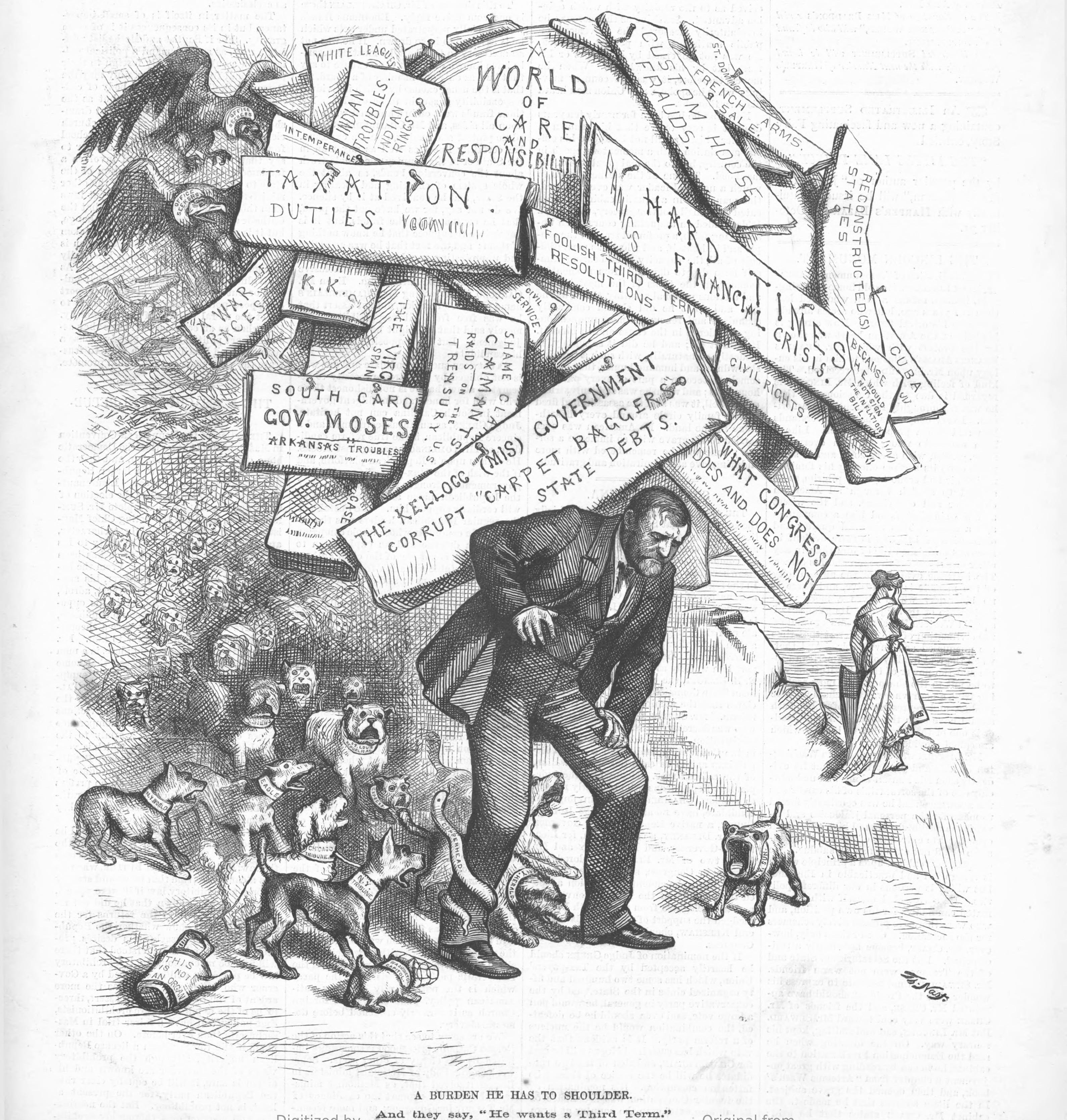
Blaine and other Republicans would soon find out that such expectations were premature. While the party would dominate presidential elections well into the 20th century, its hold on Congress was about to become much less secure.
The midterm election of 1874 foreshadows in many ways the American political landscape of 2026 and tell us something about what might happen in November — if we are fortunate enough to have free and fair elections. Then, as now, voters distrusted and disliked the two parties. The economy loomed as the dominant issue for voters. As they do today, midterm elections in the Gilded Age offered an unvarnished referendum on the party in power.
Of course, there are significant differences, starting at the top. President Donald Trump commands legions of true-believing MAGA loyalists, but he is in no way comparable to Grant and has never enjoyed the acclaim accorded to the Union Army hero who defeated the Confederacy. Nor is Trump, despite his claims to the contrary, the beneficiary of a landslide victories in the popular vote.
Moreover, while poll after poll finds voters worried about their ability to make ends meet, the economic situation — as of now — is nowhere nearly as dire as it was after the Panic of 1873, which triggered the most significant depression endured by Americans until the 1930s.
Nevertheless, the midterms of 1874 are loaded with lessons for 2026.
It took less than a year after Grant took the oath of office for the pleasing prospects anticipated by Blaine and his fellow Republicans to evaporate. In the winter of 1872-1873, a devastating scandal involving profiteering congressmen and the increasingly mistrusted Union Pacific Railroad consumed Washington and dominated the front pages of newspapers.
Congressional investigations into the so-called Credit Mobilier affair revealed dissembling and profiteering by lawmakers — all but one of whom were Republicans. Still, they resulted in no action other than slap-on-the-wrist censure for two lawmakers who planned to retire.
Outrage provoked by the Credit Mobilier scandal reached a crescendo when Congress gave itself a hefty retroactive pay raise before it adjourned. Headline writers dubbed the maneuver “the salary grab.” Democrats and Republicans alike were outraged.
On top of everything else, the persistence of white terrorism in the states of the former Confederacy shocked the country. On April 18, 1873, a white militia stormed a Louisiana town defended by armed Black forces deployed to prevent a violent takeover of the county government by Democrats. The Colfax massacre left more than 100 Black militia dead by one estimate and produced scenes “positively appalling in their atrocity,” according to the New York Times.3
While self-inflicted wounds and continued chaos in the South badly damaged the Republican brand as Grant started his second term, it was the Panic of 1873 and the ensuing depression — the worst in America until the 1930s — that accelerated the decline in the party’s fortunes. The collapse of Jay Cooke’s banking house in September 1873 forced banks to close and the New York Stock Exchange to shut down for 10 days.
Over the next six months, factories and mines closed. Unemployment ballooned. Soup kitchens and bread lines proliferated in Northern cities. “Wrecks of business enterprises were everywhere visible, the financial markets of the world were disturbed and alarmed, and hesitation filled the minds of senators and representatives,” Blaine wrote. “A black flag seemed to overhang the finances of the Government as well as individuals.”4
Congress responded with what would be called today “stimulus” legislation to inflate the money supply and stimulate business activity. The measure added $64 million to the currency and represented a “relatively modest” victory for advocates of an expanded money supply, but Grant vetoed the bill. Congress failed to override.
Conservatives of the era — confusingly referred to then as “liberals” — rejoiced, and business interests breathed a sigh of relief. “This message is calculated to have a beneficial effect upon the business of the country,” the Chicago Tribune exulted.5
It certainly didn’t help Republicans in the fall.
In what proved the first “wave” election of the modern era, Republicans lost 91 seats in the House as Democrats — still saddled with the legacy of their ambivalence about secession — gained a majority in the House for the first time since 1858. “Rarely,” historian Richard White observed, “has an American political party suffered on the scale that the Republican Party did in the congressional elections of 1874.”6
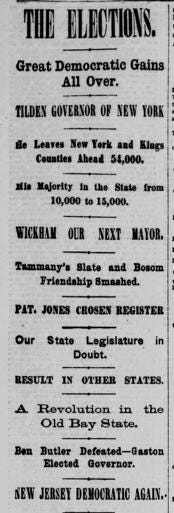
For those looking ahead to November, the midterm elections of 1874 offer several cautionary lessons for Republicans. When voters are angry with the party in power, not even a popular president can withstand the wave of disgust and fury. Trump, despite his legions of MAGA acolytes, doesn’t come close to claiming the respect with which Americans regarded Grant.
A political party associated with deeply unpopular policies — whether they involve immigration enforcement, tariffs, health care, or monetary policy — faces a difficult challenge. This year, that challenge is made more difficult by the slavish posture adopted by congressional Republicans eager to stay in the good graces of the president.
Republicans learned two years after Grant’s landslide how quickly — and how dramatically — the political environment can turn. That should be a sobering thought for their partisan heirs, whose hold on power in Washington is much shakier than it was less than a decade after the end of the Civil War.
The American Presidency Project [www.presidency.ucsb.edu/statistics/elections/1872]; U.S. House of Representatives, History, Art, and Archives, “Party Divisions of the House of Representatives, 1789 to Present” [history.house.gov/Institution/Party-Divisions/Party-Divisions/], Hereafter referred to as House; United States Senate, Party Division [www.senate.gov/history/partydiv.htm]
James G. Blaine, Twenty Years of Congress, Vol. 2 (Norwich, Conn.: Henry Bill Publishing Co., 1886), p. 549. Hereafter referred to as Blaine.
“Grant Parish,” New York Times, April 1, 1873, p. 1.
Blaine, p. 549.
Richard White, The Republic For Which It Stands: The United States During Reconstruction and the Gilded Age, 1865-1896 (New York: Oxford University Press, 2017), p. 274. Hereafter referred to as White; “The veto message,” Chicago Tribune, April 24,1874, p. 4.
House; White, p. 274.
Another factor is the "surge and decline" theory. Lots of people turn out to vote for a president (esp. a war hero such as Grant) and but are not engaged enough with politics to vote in the off-year elections.
In 1874, voter turnout was 7 percent lower than in 1872. If most of those 7 percent were Grant supporters, their decisions not to vote in 1874 might explain why many Republicans lost.
I wish we had good data on how many individuals actually voted for Republicans in 1872 and then voted for Democrats in 1874. Then we could better evaluate how much of the wave was a result of the change in who voted versus a change in how people felt.