

"Unconditional Surrender" Trump?
A brief history of the phrase invoked by two great Americans, and what it says -- and doesn't say -- about Donald Trump.

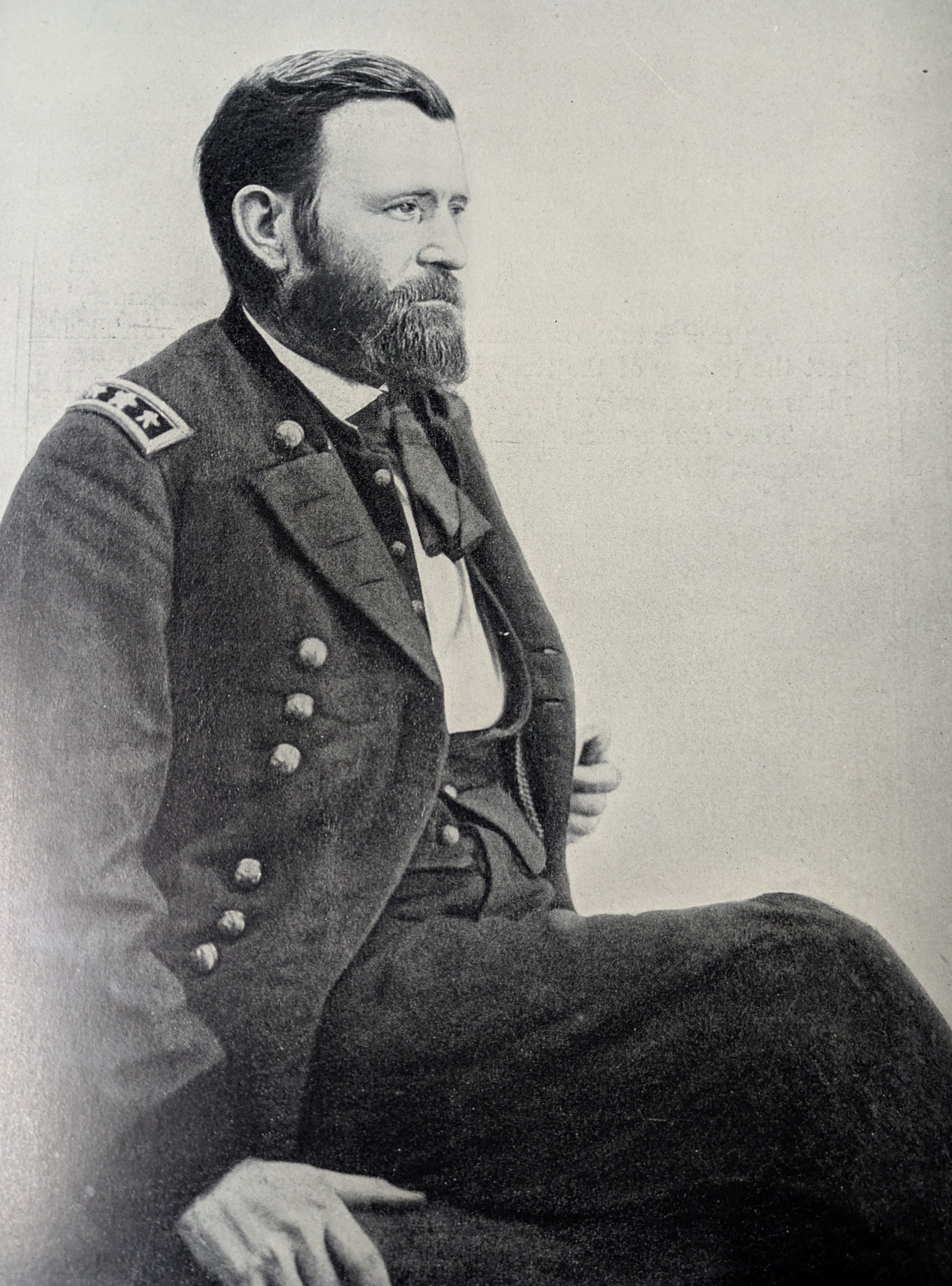
Ulysses S. Grant. Franklin D. Roosevelt. Donald J. Trump.
To paraphrase the classic “Sesame Street” tune, one of these people “is not like the others.”
Trump last week revealed the dangerously grandiose nature of his ambitions in Iran by employing a famous phrase invoked by two American heroes to convey their determination to vanquish America’s enemies.
On his social media feed, Trump vowed that “There will be no deal with Iran except UNCONDITIONAL SURRENDER!” Characteristically, Trump waffled in the days that followed. In a subsequent interview with CBS News, Trump — speaking from one of his golf properties — claimed that “the war is very complete, pretty much.” But then he warned that if Iran attempted to obstruct the Strait of Hormuz through which much of the world’s oil passes, “it's going to be the end of that country.”1
Since then, Iran has laced the strait with mines and bottlenecked oil tankers in the gulf. As of Friday morning, oil prices lingered near $100 per barrel and U.S. gas prices rose to $3.63 per gallon, a 22 percent increase since the war began. The U.S. has temporarily lifted sanctions on the sale of Russian oil as Western nations tap into reserves to keep prices down.2
The war is either almost over, or it’s about to enter a new phase. Whatever happens, it’s worth pondering what “unconditional surrender” meant to Grant and Roosevelt.
In the early years of the Civil War, Northern victories had been few and far between until Grant took command of forces moving south from Cairo, Ill. In February 1862, the Union Army attacked Fort Donelson along the banks of the Cumberland River in Tennessee.
After two days of heavy fighting, white flags of surrender went up above the rebel fort. Gen. Simon Bolivar Buckner, a classmate of Grant’s at West Point, wanted a parley about the terms of surrender. Grant responded by telling Buckner there would be no negotiation.
“No terms except an unconditional and immediate surrender can be accepted,” Grant wrote in a brief message to the rebel commander. “I propose to move immediately upon your works.” Buckner had no choice but to accept, and Grant’s reputation soared. Grant “became the war’s first certified hero,” according to biographer Ron Chernow.
In the years to come, Americans would become familiar with the soldier who relentlessly prosecuted the war to save the Union and whose humility stands in stark contrast to the vainglorious posturing of the U.S. president. “He was a superior version of the ordinary American and the public loved it,” Chernow wrote of the general who became known as “Unconditional Surrender” Grant. “As a general, he epitomized the fighting soldier, bashful and self-effacing, who went about his grim business without any self-aggrandizement.”3
“Unconditional surrender” reflected the determined pursuit of battlefield victory that sustained Grant through setbacks (Shiloh and Spotsylvania Courthouse) and triumphs (Vicksburg and Richmond) that led, more than three years later, to the rebel surrender at Appomattox.
In 1943, during his wartime summit meeting with Churchill in Casablanca, FDR told a press conference that the allies were committed to prosecuting the war against Germany and Japan until the Axis powers completely capitulated.
“The elimination of German, Japanese and Italian war power means the unconditional surrender by Germany, Italy, and Japan. That means a reasonable assurance of future world peace. It does not mean the destruction of the population of Germany, Italy, or Japan, but it does mean the destruction of the philosophies in those countries which are based on conquest and the subjugation of other people.”4
That sounds an awful lot like the nation-building that Trump, his isolationist allies, and isolationist-adjacent conservative “realists” habitually dismiss. By the way: post-war nation-building in Western Europe and Japan represents one of the greatest achievements of U.S. foreign policy.
In any event, FDR’s use of the phrase did not signal that the end of the war was at hand. Indeed, two years of hard fighting across Europe and the Pacific islands lay ahead, while Soviet troops pushed west against the Nazi war machine despite unimaginably heavy losses.
Two weeks into the war with Iran, we still lack a straightforward and thorough statement of U.S. goals and intentions. Other things are clearer. Airstrikes killed Ayatollah Ali Khamenei and top Iranian leaders, but the clerical regime remains in power and is determined to keep fighting. In addition to closing the Strait of Hormuz, Iran continues to threaten U.S. allies in the Persian Gulf with missiles and drones.
Russia benefits because the war has raised global oil prices and depleted the U.S. supply of Patriot missiles on which Ukraine depends to defend itself. Trump’s weird affinity for Russian President Vladimir Putin is well known, but only the isolationists and the Putin fanboys of the right could consider a boost to the Russian economy or crippling Ukraine’s capacity to defend itself worthwhile developments.
Israel’s aim, according to The Economist, is straightforward: “to demolish the threat posed by Iran’s regime.” But no one — including, in all likelihood, Trump himself — knows exactly what the U.S. is trying to achieve.
“When you command a machine as lethal and overwhelming as America’s armed forces,” the British newsweekly argued, “you have a special responsibility to define what you want to achieve. That is not only an ethical requirement; it is a practical one, too. War aims direct the campaign; they define the sacrifices the state imposes on its own people and the enemy; and they determine when the fighting should end.”5
If the “unconditional surrender” of Iran is indeed the U.S. goal in this war, Trump must be honest about it. It would require careful planning, painful sacrifices from the American public, and a leader who could provide a statement of war aims that is more serious than flippant social-media braggadocio. The prosecution of such a war would, almost certainly, take years and require U.S. ground forces.
It isn’t likely that Trump considered that when he tried to associate himself with two of America’s greatest wartime leaders.
Weijia Jiang, “Trump says “the war is very complete,” and he’s considering taking over Strait of Hormuz,” CBS News [https://www.cbsnews.com/news/trump-iran-cbs-news-the-war-is-very-complete-strait-hormuz]
Julian E. Barnes, “U.S. Officials Say Iran Is Laying Mines in the Strait of Hormuz,” New York Times, March 12, 2026 [https://www.nytimes.com/2026/03/12/world/middleeast/iran-mines-strait-of-hormuz-us.html]; New York Times, “Oil Prices Rise Despite Trump’s Decision to Lift Russia Sanctions,” [www.nytimes.com/2026/03/12/business/oil-stock-gas-markets-iran.html?];
Ron Chernow, Grant (New York: Penguin Books, 2018), p. 185.
U.S. State Department, Office of the Historian, “Foreign Relations of the United States, The Conferences at Washington, 1941–1942, and Casablanca, 1943, Transcript of Press Conference, Jan. 24, 1943” [https://history.state.gov/historicaldocuments/frus1941-43/d395]
“A war without a strategy,” The Economist, March 7, 2026, p. 11.
One quibble: your use of the word "weird" in the phrase "Trump’s weird affinity for Russian President Vladimir Putin." I think Trump's affinity for an authoritarian leader with Christian nationalist sympathies is one of the easier parts of his thinking to explain.