

Washington's looming "newspaper war"
Politico founder Robert Allbritton plans to take on the Washington Post on its home turf.

Draconian personnel cuts at the Washington Post may yield an unexpected benefit for residents of the nation's capital and news consumers around the world: a 21st-century version of an old-fashioned “newspaper war.”
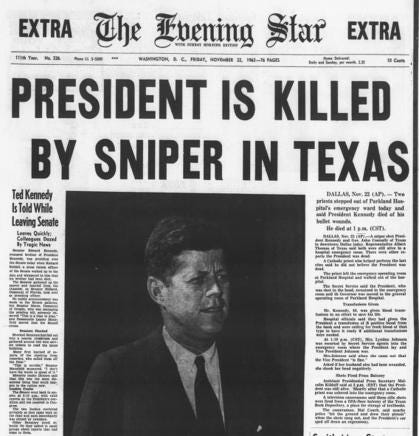
Robert Allbritton, founder of Politico and son of one of the last owners of the Washington Star, plans to launch a news site focusing on politics and the region's now-underserved demand for local news and sports coverage. Drawing on his family's legacy and perhaps tweaking Post owner Jeff Bezos in the process, Allbritton told the Wall Street Journal that he plans to call the online publication “The Star.”1
The Journal noted that Allbritton had explored naming the new venture the “Washington Star” but decided to drop “Washington” from the name to avoid entanglement in a trademark dispute and “reflect broader coverage.”
Even so, its primary focus will be Washington and its environs. “We are a factory town,” Allbritton told the Journal. “Detroit makes cars, we make government.” Dana Milbank, a longtime Post columnist who numbers among the former Post employees who have flocked to the new venture, said The Star will launch in early June.2
The Post laid off an estimated 350 newsroom employees in February following a series of buyouts. The sports section was gutted, and coverage of local news drastically diminished. All staff photographers were sent packing. A collateral casualty was Sir Will Lewis, who resigned as publisher after he was photographed on the red carpet at a Super Bowl event following the layoff announcement.3
Since then, some local sports coverage has been restored, and a handful of laid-off reporters were hired back.
According to the Journal, “Allbritton canceled a Caribbean cruise, flew his jet home to Washington, D.C., and started planning” to mount a robust challenge to the Post as the scale of its newsroom exodus became clear. Referring to the diaspora of departed Post reporters and editors, Allbritton reportedly urged his team to “Take ‘em all.”4
The prospect that Allbritton is assembling a newsroom to compete against the Post on its home turf hearkens back to the days when daily newspapers battled for readership and advertising in cities throughout the United States. It is a potentially healthy development, not only for D.C. and its surrounding suburbs, but also for the marketplace of ideas and information.
This promises to be a 21st-century version of the “newspaper wars” that were once commonplace across the United States. Publishers and editors fought each other with competitive news coverage, promotions, and features — all aimed at attracting readers, advertising dollars, and market dominance.
That was the battle space that prevailed in Washington through the first half of the last century. As late as 1954, the nation’s capital was home to four daily newspapers: the Daily News, the Evening Star, the Post, and the Times-Herald. When the Post bought the Times-Herald from Chicago Tribune publisher Robert McCormick in 1954, it consolidated its competitive position and eventually overtook the long-dominant Evening Star. The Daily News closed in 1972 after the Evening Star bought it. Nine years later, the Star — by then a morning competitor with the Post — shut down. The conservative Washington Times began publication the following year but has never approached the Post in circulation or influence.
With print dying before our eyes, the “newspaper wars” of the 21st century will be fought online.
For years, the Post dominated the local news market and ranked among the nation’s elite news organizations, leading the way on coverage of the Watergate scandal and, more than four decades later, the first Trump presidency. It offered authoritative stories and commentary on world and national affairs, robust sports coverage, and must-read entertainment, lifestyle, and cultural reporting.
The Post overcame a rocky transition to the digital age but eventually found its footing. The number of digital subscribers approached 3 million in 2020, with monthly visitors reaching 139 million in March of that year.5
Those numbers began to decline after Trump left office following his 2020 defeat by Joe Biden. By 2022, monthly website visits had plummeted to 58 million, and more than 500,000 subscribers had left. Red ink stained the books, reportedly reaching $177 million by 2023.6
Instead of providing the “runway” he promised when he bought the Post in 2015, Bezos has apparently embraced the formula that has failed legacy media throughout the world: cutting payroll to return to profitability. To turn things around, he brought in Lewis, an acclaimed — but controversial — Fleet Street journalist who proved to be the greatest British bust in North America since Lord Cornwallis at Yorktown. Losses continued under Lewis, reaching $100 million in 2024 and “even more in 2025,” according to Farhi.7
Despite everything, the Post remains an essential news source, as its two 2026 Pulitzer prizes show. Its coverage of the Trump administration is tenacious and appropriately adversarial. But it has severely — and perhaps irrevocably — compromised its standing with hundreds of thousands of digital subscribers. More than 250,000 vowed to cancel their subscriptions after Bezos made an ill-timed decision to withhold an endorsement of Kamala Harris in 2024. An additional 60,000 subscribers fled after the February layoffs.8
I will remain a subscriber to the Post while subscribing to the Star after it starts up. Readers in the D.C. area and beyond stand to benefit from the addition of another reputable news outlet. The Post will be strengthened, one hopes, by the competition for readers. This is one war where everyone stands to benefit.
For those who wonder: I italicize the Post because it is a newspaper with an online presence. The Star and other online news sources do not require italicization.
Alexandra Bruell, “Allbritton Seeks to Scoop Up Post Role, ” The Wall Street Journal, April 27, 2026, p. B1. Hereafter referred to as Bruell; Dana Milbank, “What Did I Miss?” NOTUS Perspectives [www.notus.org/perspectives/i-mostly-ignored-politics-for-10-months-what-did-i-miss]
Paul Farhi, “How Will Lewis Lost the Washington Post,” Washingtonian, March 19, 2026 [https://washingtonian.com/2026/03/19/will-lewis-the-washington-post/]. Hereafter referred to as Farhi.
Bruell.
Farhi.
Ibid.
Ibid.
David Folkenflik, “More than 250,000 subscribers have left ‘Washington Post’ over withheld endorsement,” NPR, Oct. 29, 2024 [/www.npr.org/2024/10/29/nx-s1-5170939/more-than-250-000-subscribers-have-left-washington-post-over-withheld-endorsement]; Benjamin Mullin, Erik Wemple, and Katie Robertson, “How Jeff Bezos Upended The Washington Post,” New York Times, March 14, 2026 [www.nytimes.com/2026/03/14/business/media/washington-post-jeff-bezos-layoffs.html
I hope competition works in DC. I don't think the competition in Chicago between the Tribune and the Sun-Times has made either paper stronger. But it does give people a choice--a place to go when the leadership at one paper seems deeply incompetent.
Thanks for the update, Robert. I was a faithful reader of thee Washington Post from my college days there beginning in 1973, up through just a couple of months ago, when I couldn't take the continued layoffs and especially the increasing approval of Trump in the editorials.
I couldn't believe my luck when I got the Post every morning at my dorm room door, usually featuring the latest Watergate revelations from Woodward and Bernstein and others. I came back home on bought the Post regularly, and subscribed to the weekly print digest version they published for a few years. I subscribed online as soon as that became available.
In college I would also occasionally read the Washington Star. They had an architecture critic whom I liked-- and who later replaced the famous Wolf Von Eckardt at the Post. But in the early '70s, to me at least, the Star was clearly an also-ran and afterthought. I actually remember Joseph Albritton better as the owner of Channel 7 in Washington, then called WMAL.
All of which is to say I would love to be able to follow Washington news regularly again, and I look forward to seeing the new Star. I hope it succeeds.
Thanks again.